
Share This Article
This post may contain affiliate links and we may get paid a small commission if you click on a link.
Please read our privacy policy and cookie policy.
If you’ve ever struggled to figure out whether your hair is 4A, 4B, or 4C – you’re not alone. Curl typing can feel confusing, especially when your hair looks different depending on whether it’s stretched, wet, moisturised, or freshly washed.
Many people get confused because there are similarities between the three textures, and it’s also possible to have multiple curl patterns across different areas of your head. Product marketing and social media can also blur the lines between hair types, making curl typing feel even more confusing.
While understanding your hair type can help you choose products and routines more effectively, healthy hair practices matter far more than fitting perfectly into one category. We’ll be using the Type 4 hair chart to help you understand the differences between 4A, 4B, and 4C curl patterns. From texture appearance, shrinkage to maintenance and common challenges.
What Is the Type 4 Hair System?
Type 4 hair consists of three main subcategories: 4A, 4B, and 4C hair. They are grouped together because they share tightly coiled strand patterns that may form S-shaped coils or tighter zig-zag bends. Although there are similarities between the three, each texture has slightly different characteristics.
What Does “Type 4 Hair” Mean?
The Type 4 hair system was created by Andre Walker in the 1990’s. While the system was originally created alongside Walker’s haircare line, it has since become one of the most widely recognised curl typing systems.
Walker describes Type 4 hair as tightly coiled strands with either a Z or O shape pattern. In recent years there has been ongoing debate around the limitations of the system but it is a starting point to understand the subtypes within Type 4 hair textures.
Why Curl Patterns Can Look Different on Different People
Many people can have the same curl pattern but still experience different results due to factors such as density, porosity, strand thickness, and styling habits.
For example, two people with 4C hair may have very different experiences depending on whether their strands are fine or coarse, which can affect everything from product choice to breakage risk.
4A, 4B & 4C Hair Chart
The below hair chart highlights the main differences between 4A, 4B, and 4C curl patterns, including shrinkage, texture appearance, and common challenges associated with each hair type.
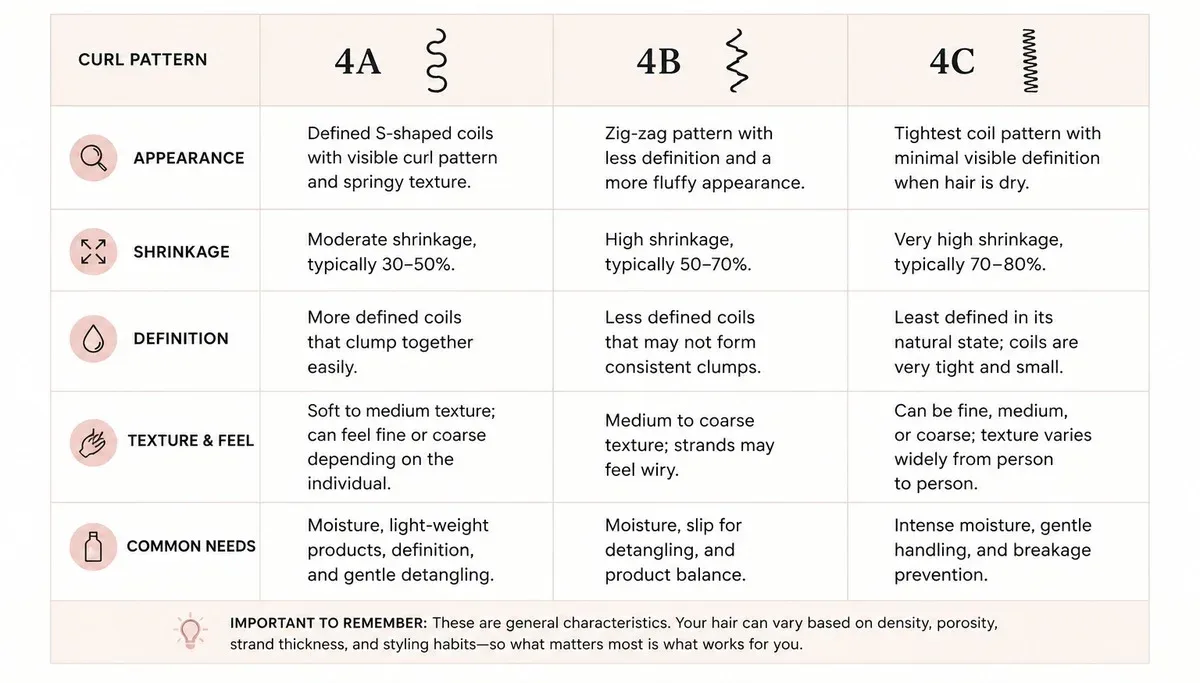
While this hair chart can help you understand different curl patterns – factors such as density, porosity, strand thickness, and styling habits also influence how your 4A, 4B or 4C hair responds to products and routines.
Misconceptions about Type 4 Hair
Although there are clear differences between 4A, 4B, and 4C hair, many people naturally have multiple curl patterns across different areas of their head. For example, you may notice tighter coils at the crown and looser curls around the hairline or nape.
Another common misconception is that all 4C hair is coarse or thick. In reality, 4C hair can be fine, medium, or coarse depending on the individual, which can affect everything from product choice to breakage risk.
What Does 4A Hair Look Like?

Characteristics of 4A Hair
4A hair typically has a visible S-shaped coil pattern with springy curls that are usually more defined than 4B or 4C hair. Depending on density and strand thickness, 4A hair may look fuller, fluffier, or more compact from person to person. Like other Type 4 hair patterns, it can still experience dryness, shrinkage, and breakage if not cared for properly.
Common Challenges With 4A Hair
One of the biggest misconceptions about 4A hair is that it is “easy” to manage. Like all Type 4 hair, 4A hair is naturally prone to dryness because the bends and coils make it harder for natural oils to travel down the hair shaft. Over-manipulation, excessive heat styling, and product buildup can also lead to tangling and breakage over time.
What Does 4B Hair Look Like?

Characteristics of 4B Hair
4B hair has a tighter curl pattern with strands that often form sharp bends or zig-zag shapes rather than defined ringlets. Compared to 4A hair, the coils often appear less defined and more densely packed together, creating a fuller, fluffier appearance. Depending on strand thickness and density, 4B hair can range from soft and fine to thick and wiry in texture.
Common Challenges With 4B Hair
4B hair can be more susceptible to tangling, dryness, and breakage from excessive manipulation. Product buildup may also become an issue when heavy creams and oils are layered too frequently without regular cleansing.
What Does 4C Hair Look Like?
Characteristics of 4C Hair
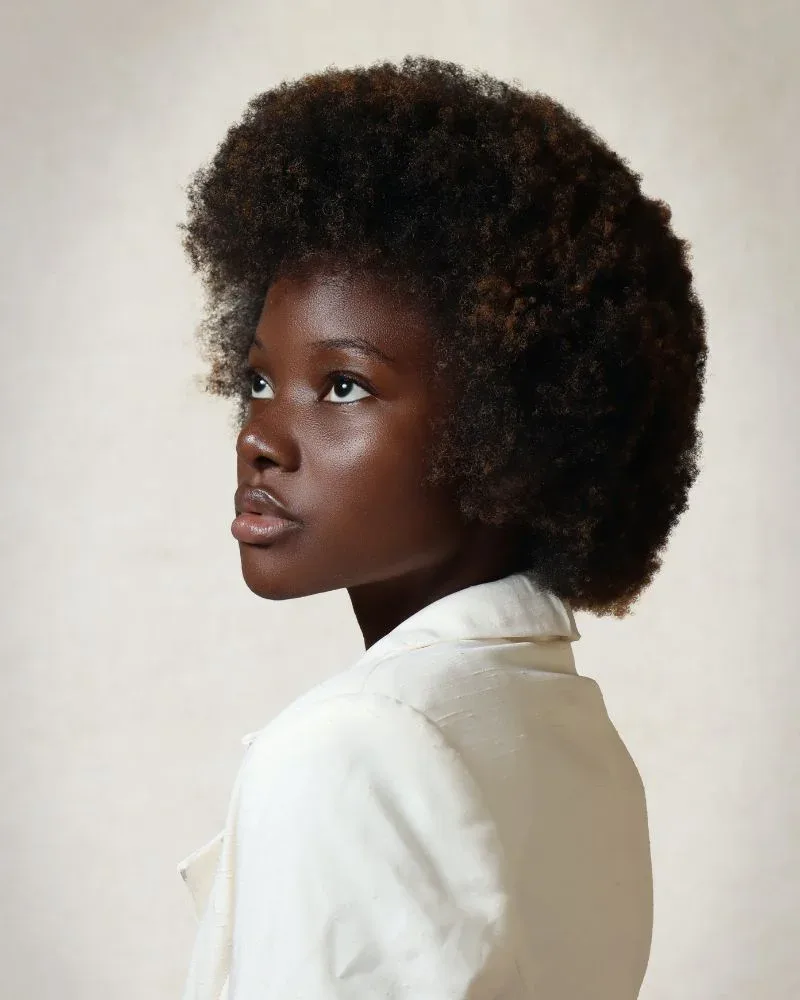
4C hair has the tightest coil pattern within the Type 4 category and typically experiences the most shrinkage, sometimes shrinking up to 70 to 80% of its actual length when dry. Unlike 4A hair, the curl pattern may appear less visibly defined in its natural dry state.
One of the biggest misconceptions about 4C hair is that it’s always coarse or hard to maintain. In reality, 4C hair can be fine, soft, coarse, dense, or low-density depending on the individual. While this texture is naturally beautiful and versatile, the tight bends throughout the strand can make it more prone to dryness, tangling, and breakage if not handled gently.
Why 4C Hair Is Often Misunderstood
4C hair is often misunderstood because many people associate shrinkage or lack of visible definition with “unhealthy” hair. Historically, tighter textures have faced texture discrimination, leading many people to feel pressure to straighten or alter their natural hair pattern.
Another common misconception is that all 4C hair looks or behaves the same. In reality, shrinkage, density, softness, and styling preferences can vary significantly from person to person. Shrinkage is also completely normal and is often a sign of elasticity and healthy hair rather than damage.
Common Challenges With 4C Hair
Because of the tight coils and multiple bends throughout the strand, 4C hair can be more susceptible to dryness, tangling, single strand knots, and breakage from excessive manipulation. The multiple bends along the hair fibre create more areas where breakage can occur, especially when the hair is dry or handled roughly. This is why gentle detangling, moisture retention, and protective styling often play an important role in reducing breakage and supporting length retention within many 4C hair routines.
Can You Have Multiple Curl Patterns?
Yes, it is completely normal to have multiple curl patterns across different areas of your head. For example, the front of your hair may appear slightly looser than the back depending on your styling habits. For example, I noticed my parting section became slightly looser than the back of my hair after frequently wearing slick back buns, as the constant stretching gradually altered the curl pattern over time.
Hair follicles across areas such as the nape, crown, and hairline can naturally grow at different angles and shapes, which is why some areas may appear tighter, looser, denser, or more defined than others.
Why Your Crown, Edges & Back May Look Different
Genetics play a major role in why your crown, edges, and the back of your hair may have different curl patterns, textures, or densities.
Hormonal changes, postpartum shedding, and nutritional deficiencies such as low vitamin D or iron, and excessive tension from tight hairstyles can also affect the appearance and density of certain areas over time. Frequent heat styling may also temporarily alter the curl pattern, especially when high temperatures are used regularly.
Curl Pattern vs Hair Health: What Actually Matters Most?
Understanding the differences between 4A, 4B, and 4C hair should not completely determine how you approach your haircare routine. Your hair’s overall health matters more. Knowing your hair type can help you choose products and understand your hair’s characteristics, but healthy hair practices matter far more in the long run.
Fine vs Coarse Hair Matters Too
Knowing if you have fine or coarse hair is equally as important as knowing your hair type. Two people can have the same curl pattern but completely different strand thicknesses, which can affect everything from product selection to styling and breakage risk. People with finer 4A, 4B, or 4C strands may experience more breakage because fine hair is generally more delicate and susceptible to mechanical damage. This is because fine hair types are more easily weighed down by heavy products or product buildup. Read our guide on fine natural hair to learn more.
Healthy Hair Comes Down to Routine & Consistency
Knowing whether your hair is 4A, 4B, or 4C can help you understand your hair’s characteristics, but it does not determine whether your hair can grow long or remain healthy. Hair growth is influenced more by genetics, scalp health, overall health, and how well you maintain your hair over time.
Consistent washing, moisturising, reducing excessive manipulation, trimming damaged ends, and maintaining a healthy scalp often play a much bigger role in length retention than curl pattern alone. While understanding your texture is helpful, building a realistic and consistent routine matters far more in the long run.
How to Care for 4A, 4B & 4C Hair
Here are some of the most important areas to focus on when building a healthy Type 4 hair routine.
Focus on Moisture & Gentle Cleansing
Moisture plays a major role in reducing dryness and minimising breakage within Type 4 hair routines. However, moisture is not just about layering heavy products onto the hair. Ingredients such as glycerin and aloe vera help attract water to the hair, while regular cleansing helps prevent buildup from making it harder for moisture to properly penetrate the hair.
Reduce Excess Manipulation
Excessive manipulation is one of the biggest causes of breakage within Type 4 hair routines. Rough detangling, excessive brushing, and constantly restyling the hair can increase breakage over time, especially on finer strands. Using products with good slip can make detangling easier and help reduce unnecessary tension on the hair.
Protect Your Ends
Protecting your ends can help minimize dryness, tangling, and single strand knots. Constant friction from clothing, scarves, or excessive manipulation can increase wear on the oldest parts of the hair, making the ends more prone to breakage over time.
Clarify Regularly to Prevent Buildup
Clarifying your hair regularly helps remove product buildup so moisture can properly penetrate the hair strands. Over time, layers of products can coat the hair and make it harder for moisture to properly penetrate the strands.Depending on your styling routine and product usage, clarifying once or twice a month may help improve how your hair responds to moisturising products.
Use Heat Carefully
Heat is not automatically damaging, but excessive heat usage or poor technique can increase dryness and breakage over time. Using heat protectants alongside appropriate heat settings can help minimise damage when blow drying or straightening Type 4 hair.
Best Ingredients for Type 4 Hair
Type 4 hair often benefits from ingredients that improve moisture retention, softness, and manageability without causing excessive buildup. Humectants such as aloe vera, glycerin, and honey help draw moisture into the hair, while conditioning ingredients such as behentrimonium methosulfate and fatty alcohols help soften the hair and reduce friction during detangling.
Products with good slip are especially helpful for minimising tangling and reducing breakage during detangling and wash day routines. Depending on your strand thickness, density, and styling preferences, some people may prefer lightweight moisturising products while others benefit from richer creams and butters.
Hydrolysed proteins and bond-building ingredients may also help strengthen weakened strands and improve hair elasticity, particularly for hair damaged by excessive heat styling, colouring, or manipulation.
Oils and butters can help seal moisture into the hair, but they do not moisturise the hair directly. This is why hydration-based products such as water-based leave-ins and conditioners still play an important role within healthy Type 4 hair routines.
If you’re unsure which protein or bond-building treatments may work best for your hair, read our guide here.
Final Thoughts: Understanding Your Curl Pattern Without Obsessing Over Labels
Use this hair chart as a guide to better understand 4A, 4B & 4C hair. But also consider factors such as porosity, density, and strand thickness when building your routine. The goal is not to force your hair into a category, but to create consistent habits that support healthier hair over time.
Consistency matters far more than perfection. Pay attention to how your hair responds, minimise excessive manipulation, and adjust your products or styling methods when needed. Whether you have 4A, 4B, or 4C hair, healthy hair starts with understanding and caring for your texture in a way that works for you.
FAQs About 4A, 4B & 4C Hair
4A hair typically has a more visible S-shaped coil pattern, while 4B hair has tighter zig-zag bends with less definition. 4C hair typically experiences the most shrinkage and may appear less defined in its natural dry state. However, factors such as density, strand thickness, and styling habits can also affect how each curl pattern looks.
The easiest way to identify your curl pattern is to observe your hair in its natural state after washing and conditioning. 4A hair usually has visible S-shaped coils, 4B hair tends to form tighter zig-zag bends, and 4C hair often has the tightest shrinkage with less visible definition when dry. However, many people have a mix of curl patterns across their head.
Yes, it is completely normal to have multiple curl patterns across different areas of your head. Some people may have tighter coils around the crown and looser curls near the nape or hairline. Genetics, heat styling, tension, and hair damage can also influence curl pattern variations.
4C hair shrinks because of its tightly coiled structure. The tighter the curl pattern, the more the hair naturally coils back onto itself. Shrinkage is completely normal and is often a sign of elasticity and healthy hair rather than damage.
Yes, 4C hair can absolutely grow long. Curl pattern does not determine whether your hair will grow or retain length. However, because 4C hair is more prone to shrinkage, dryness, and breakage from excessive manipulation, retaining length often comes down to consistent haircare practices such as gentle detangling, moisturising, scalp care, and protecting the ends of the hair.
No. One of the biggest misconceptions about 4C hair is that it is always coarse or thick. In reality, 4C hair can be fine, medium, or coarse depending on the individual. Curl pattern and strand thickness are two different things.