

Share This Article
This post may contain affiliate links and we may get paid a small commission if you click on a link.
Please read our privacy policy and cookie policy.
BBraids are one of the most popular protective hairstyles for Black women. They’re long-lasting, versatile and convenient for holidays or breaks from daily styling. But do braids actually help your natural hair grow?
Braids do not make your hair grow faster. However, they can support length retention by reducing daily manipulation, tangling and breakage. The results depend on how your braids are installed, maintained and removed.
Tight or heavy braids can cause breakage, so low tension and proper maintenance are essential. This guide explains how braids can support your hair growth goals. You’ll also learn what can support or harm length retention.
Are Braids Good for Length Retention?
Yes, braids can support length retention when you install, maintain and remove them carefully. They reduce daily handling and help protect fragile ends. However, braid size, length, weight and tension all affect the result. Here are three ways braids can support length retention:
Less Manipulation
Braids reduce the need for daily styling, combing and restyling. Less handling can reduce friction and mechanical breakage. However, braids only protect your hair when they do not create excessive tension.
Minimal Detangling
Type 4 hair can tangle easily because each strand follows a tightly curled pattern. Braids keep your strands separated and reduce the need for regular detangling. Less handling may lower the risk of breakage.
You must still detangle carefully after removing your braids. Use a product with enough slip and work through your hair in sections. This helps release trapped shed hairs without causing unnecessary breakage.
Protected Ends
Your ends are the oldest and most fragile parts of your hair. They face regular friction, tangling, knots and general wear. Braids can reduce this exposure by keeping your ends tucked away. Protecting your ends may reduce breakage and help you retain more length between trims.
Do Braids Help Your Hair Grow?
Braids do not make your hair grow faster. Hair growth starts inside the follicles beneath your scalp. New cells form in the hair bulb, then harden and move upwards to create each strand. Hair follows a growth cycle that includes the anagen, catagen and telogen phases.1
Anagen is the active growth phase, when the hair follicle produces new hair. Genetics, age, health and nutrition can influence this process. However, wearing braids cannot change your natural growth rate.
Braids can make your growth easier to notice. As your braids loosen, the space around your roots makes new growth more visible. This can create the impression your hair has grown faster than usual.
Although braids cannot accelerate growth, they may help you retain more of it. They reduce daily manipulation and can protect your strands from unnecessary breakage. However, tight, heavy or poorly maintained braids can have the opposite effect.
Is It Healthy to Put Your Hair in Braids?
Braids can form part of a healthy natural hair routine. However, no braided style is automatically protective.
Braids can reduce daily handling, friction and styling. However, they do not lock in moisture or prevent all breakage. Your installation, maintenance and removal determine whether the style protects your hair.
Healthy braids should:
- Feel comfortable from the day of installation
- Use a suitable amount of added hair
- Avoid pulling around your edges
- Allow easy access to your scalp
- Remain clean, moisturised and thoroughly dried
Loosen or remove your braids if they cause pain, bumps or persistent irritation. These symptoms can signal excessive tension on your scalp and hair follicles.
Are Braids Good for Thinning Hair?
Braids may worsen existing thinning, especially when the style uses tight sections or heavy extensions. Added hair increases the weight placed on your natural hair and follicles. Avoid extension braids if you notice thinning edges, bald patches, scalp pain or unexplained hair loss. Speak with a dermatologist before installing another long-term protective style.
Do not assume crochet braids are automatically safer. The cornrow base can still create tension, while the added hair can increase weight. If your hair can tolerate braids, choose lightweight and low-tension options. Braids using only your natural hair may place less weight on fragile areas.
Stop wearing any style that causes pain, bumps or increased thinning. Repeated tension can cause traction alopecia and may eventually lead to permanent hair loss.2
Why Am I Losing So Much Hair After Braids?
Most people shed between 50 and 100 hairs each day.3 Braids trap many of these hairs within the style. After several weeks, the collected hair becomes visible during takedown. This does not always mean that your braids caused hair loss.
However, shedding and breakage are different. Shed hairs usually have a small, pale bulb at one end. Broken hairs often appear shorter, feel brittle and lack this bulb. Look for both signs when assessing the hair from your takedown. Contact a dermatologist if you notice bald patches, scalp pain, thinning or continued excessive shedding.
How to Reduce Breakage During Braid Takedown
1. Take Your Time
Allow enough time to remove your braids without rushing. Take regular breaks or ask someone you trust for help.
2. Unravel From the Ends
Start at the tip of each braid and work upwards. Avoid pulling the extension hair through knots or tangled sections.
3. Soften Buildup Around the Roots
Product buildup often collects where the braid meets your new growth. Apply a detangling product to soften stubborn areas. Use your fingers to separate the buildup gently. Do not force a comb through hardened knots.
4. Detangle Each Section
Detangle each completed section before moving to the next. Remove trapped shed hairs with your fingers first. Use a wide-tooth comb if you need further detangling. Start at the ends and work upwards.
How Long Should You Leave Braids In for Hair Growth and Length Retention?
For most people, six to eight weeks is the recommended maximum for wearing braids. Remove them sooner if you notice pain, bumps, persistent itching or changes around your hairline. Keeping braids longer will not make your hair grow faster. It can increase matting and make the takedown process more difficult.
How Often Should You Redo Hairline Braids?
Hairline braids often loosen faster because the hairs around your edges are shorter and more frequently styled. You do not need to redo them on a fixed schedule. Do not retwist or tighten grown-out roots to refresh the style. This can increase tension and encourage matting around the roots.
Remove the loose braid instead. Only reinstall it when your scalp feels comfortable and shows no irritation. Keep the replacement braid loose and use lightweight extension hair.
What Are the Best Braids for Length Retention?
The best braids for length retention are usually medium-sized, lightweight and low-tension. Consider these additional factors before choosing your style:
Limit the Weight and Length
Use only the amount of extension hair that each natural hair section can support. Added hair should not pull heavily from your roots. Choose a moderate length that feels comfortable during movement and styling. Long braids can place additional weight on your hair and scalp.
Consider the Braiding Hair Fibre
Traditional synthetic hair is not the only option. Ruka Hair’s Braid-it Synths®2 offers a biodegradable, collagen-based protein fibre. The fibre contains bovine collagen and may contain traces of acrylates. Check the allergen guidance before purchasing if you have known sensitivities.
Prioritise Low Tension
Your braids should feel comfortable from the day of installation. Pay extra attention to the shorter hairs around your hairline. Pain, bumps or headaches can indicate excessive tension. Loosen or remove any braid that causes these symptoms.
Choosing between styles? Compare cornrows and braids for hair growth and length retention.
Avoid Frequent High Ponytails and Buns
Wearing braids in high ponytail and bun styles can add tension around your hairline and the top of your scalp. The risk increases when you pull the style tightly or wear it regularly. Choose looser updos and vary their position. Wear your braids down between styles to give your scalp and hairline a break.
How to Maintain Braids for Length Retention
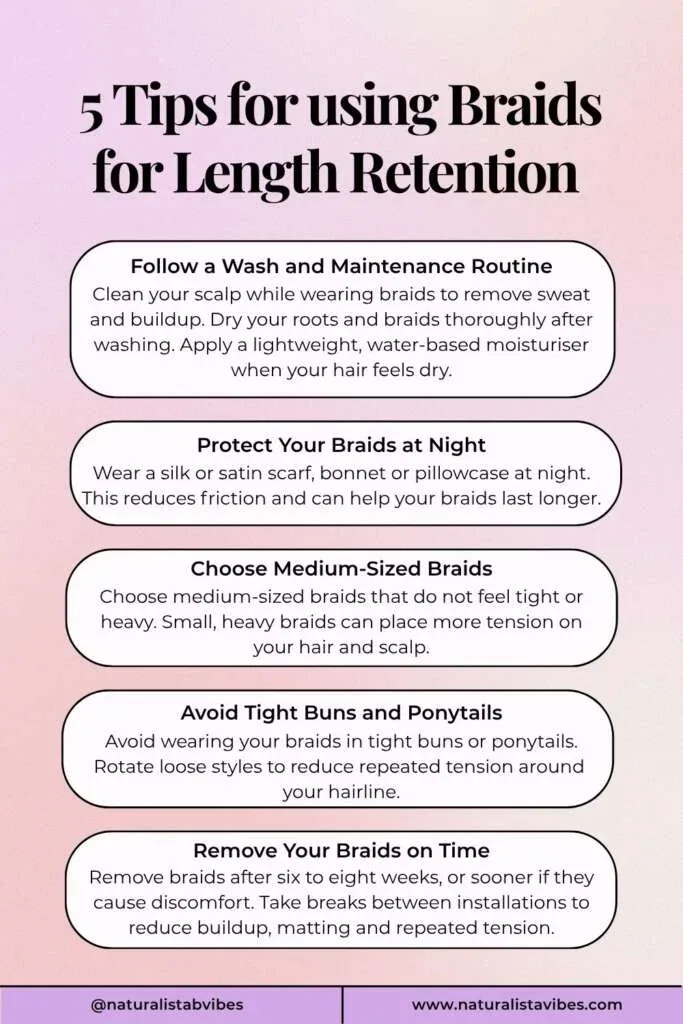
The infographic below summarises five practical ways to care for your hair and scalp while wearing braids.
Braid Maintenance Dos
1. Clean Your Scalp Carefully
Clean your scalp when you notice sweat, itching or product buildup. You may need more frequent cleansing if you exercise regularly. Apply shampoo to your scalp and massage gently. Rinse without rubbing, twisting or pulling your braids. Scalp cleansing pads can refresh your scalp between wash days. However, they should not replace regular shampooing.
Wet braids can feel heavier and pull on your roots. Support the lengths and handle them carefully during washing. If washing creates frizz, apply a small amount of mousse after your braids dry.
2. Dry Your Braids Thoroughly
Blot excess water gently without rubbing your braids. Dry your scalp and roots thoroughly using a cool or low setting. Allow the remaining lengths to air-dry completely. Prolonged dampness can contribute to odour, discomfort and scalp problems.
3. Moisturise Lightly
Your scalp produces sebum, but tight curls make it harder for oils to travel down each strand. This can leave your lengths and ends dry while braided.
Spritz a lightweight, water-based moisturiser along each braid containing your natural hair. Pay extra attention to where your natural hair ends inside the braid. Lightly dampen your hair without soaking the braids. Avoid layering too much product, as this can create unnecessary buildup.
4. Speak Up During Installation
Tell your stylist immediately if a braid feels painful or excessively tight. Ask them to loosen the section before they continue. Do not wait until the appointment ends. Addressing the tension immediately can prevent discomfort, damage and the cost of early removal.
A professional stylist should take your concerns seriously. Choose another stylist if they repeatedly ignore your requests.
5. Consider Existing Scalp Conditions
Persistent itching is not always caused by dryness or buildup. Dandruff, seborrhoeic dermatitis, psoriasis and product reactions can also irritate your scalp.4 Follow your treatment plan if you have a diagnosed scalp condition. Avoid tight installations and products that trigger flare-ups.
Do not scratch irritated skin with fingernails or pointed tools. Contact a dermatologist if you notice a rash, burning, swelling or worsening scale.
Frequently Asked Questions
Box braids do not increase your natural hair growth rate. However, lightweight box braids may support length retention by reducing daily manipulation.
Avoid small, heavy or tight box braids. These styles can increase tension and breakage.
New growth can create space between your scalp and the braid. However, braids may also loosen through washing, styling or slippage. Loose braids do not always prove that your hair has grown faster.
No. Tight braids do not increase hair growth. They can damage your strands and place unnecessary stress on your follicles. Loosen or remove braids that cause pain, bumps or headaches.
Braids do not increase the natural growth rate of 4C hair. They can make new growth easier to notice. Low-tension braids may also help retain length by reducing tangling, friction and daily manipulation.
Cornrows do not make your hair grow faster. However, they may support length retention when installed and maintained carefully. Cornrows usually require less extension hair than individual braids. This can reduce the weight placed on your scalp and individual strands.
Avoid tight or heavy cornrows that pull around your hairline. Read our guide comparing cornrows and braids for hair growth and length retention.
Sources
- How does hair grow? – Institute for Quality and Efficiency in Health Care ↩︎
- Hairstyles that pull can lead to hair loss – American Academy of Dermatology ↩︎
- Do you have hair loss or hair shedding? – American Academy of Dermatology ↩︎
- 10 reasons your scalp itches and how to get relief – American Academy of Dermatology ↩︎



1 Comment
braiding styles
A super informative and balanced guide on using braids for healthy hair and length retention—great job!
Comments are closed.